

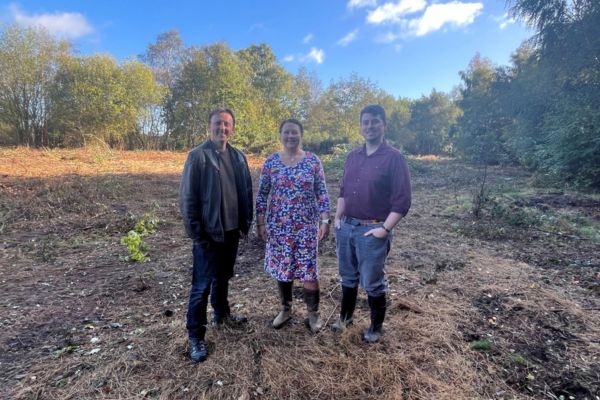
More than six hectares of rare heathland habitat are set to be restored across Lichfield District as part of work to create more space for nature and wildlife.
We are restoring heathland and associated habitats at three council-managed nature sites – Pipehill Crossroads, Ironstone Heath and Muckley Corner.
Around 0.6 hectares of heathland have already been recovered at Pipehill Crossroads, where the removal of young trees and scrub has revealed surviving heathland plants across the area.
A further 0.6 hectares of heathland and associated habitats are planned for recovery at Pipehill over the next few years.
Work is also planned at Ironstone Heath, where the initial aim is to recover around one hectare over the coming months, while a larger restoration project at Muckley Corner aims to restore around four hectares, with work on part of the site expected to begin within the next six months.
Together, the three sites represent around 6.2 hectares of planned heathland recovery and restoration.
The work forms part of our longer-term ambition through our Lichfield District 2050 Strategy to restore heathland and associated habitats and improve connections between important habitats from Cannock Chase towards Sutton Park.
Heathland is one of the UK’s rarest and most threatened habitats and provides an important home for a wide range of plants, insects, birds and reptiles.
Without careful management, heathland can gradually become dominated by scrub and eventually develop into woodland. The council’s habitat management plans therefore include carefully removing young trees and scrub, controlling bracken and invasive species, creating areas of bare ground and spreading heather and other heathland seeds.
Councillor Janice Silvester-Hall, Cabinet Member for Visitor Economy, Ecology and Climate Change, said:
“Some of this work can look quite dramatic at first, particularly when trees and scrub are being cleared, but there is an important reason behind it.
“Heathland is an incredibly valuable and increasingly rare habitat. By carefully managing these sites, we can give the plants and wildlife that depend on it the opportunity to thrive again.
“It’s fantastic that we are already finding surviving heathland plants at Pipehill, and over the coming years we should see these areas continue to develop and become richer habitats for wildlife.”
The scale of the work also makes an important contribution to wider ambitions for nature recovery across Staffordshire. The draft Staffordshire Local Nature Recovery Strategy includes a target to create or restore 40 hectares of lowland heathland across the county.
Want to find out more? Discover what we’re doing to support biodiversity and create more space for nature across Lichfield District: Biodiversity across the district